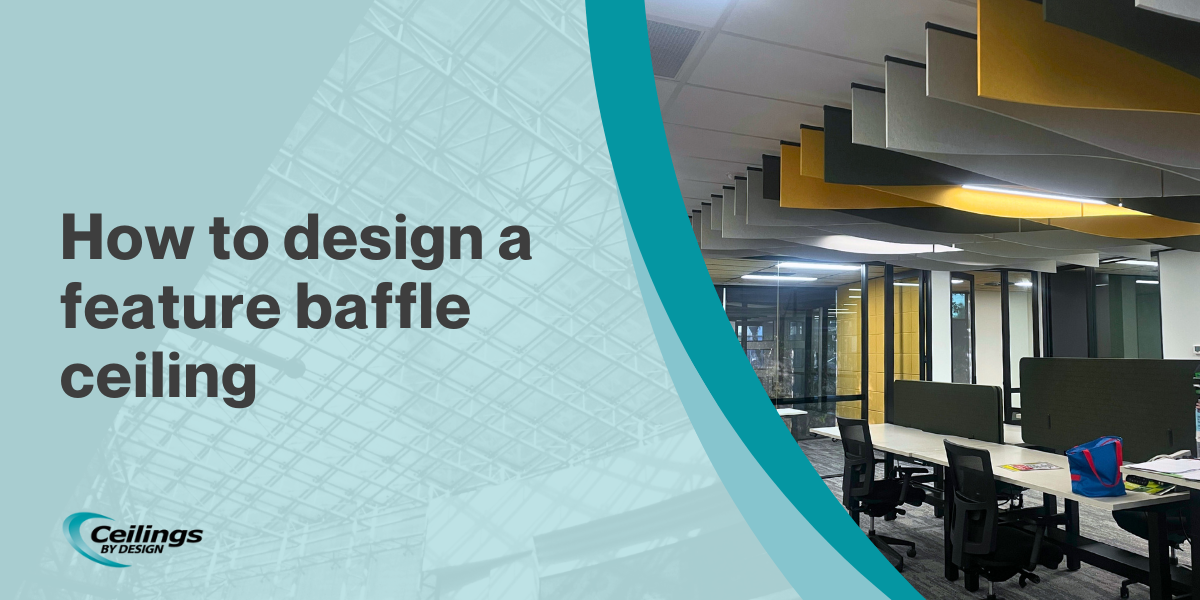
Across Australia, feature baffle ceilings are emerging as a defining design element. Architects are turning to baffles, not just for acoustic performance, but for the design and dimension freedom they offer. A statement without the constraints of full ceiling coverage.
With the rise of acoustic baffle systems, we’re seeing an industry shift toward ceilings that work harder: acoustically effective, visually refined and faster to install.
And as adoption grows, so does the need for clear design guidance. In our work with architects, builders and contractors across commercial, education, workplace and hospitality environments, we’ve found that the strongest baffle ceiling outcomes consistently come down to a handful of well-informed decisions.
Let’s break down the considerations that matter most.
Why baffle ceilings work so effectively in contemporary interiors
Feature baffle ceilings have gained momentum because they address a very practical problem in today’s interiors: hard surfaces and exposed structures create environments that are visually impressive but highly reflective. As workplaces move toward open layouts, schools adopt flexible learning spaces, and commercial projects prioritise durability and maintenance-friendly materials, the acoustic load on a room increases significantly.
Baffles offer an efficient, flexible way to introduce absorption without compromising creative expression. Ceiling tiles and acoustic panels are great options, but don’t offer the same dimension and design freedom. Learn more about how to choose between baffles and panels.
Design considerations: how to create a standout baffle ceiling
Acoustic performance
Acoustic performance is driven by one principle: coverage. The more sound-absorbing material present in a space, the more effectively it reduces reverberation and improves clarity.
In feature baffle ceiling design, coverage is influenced by several controllable variables. Understanding how each variable contributes to coverage allows architects to shape ceilings that are both visually resolved and acoustically effective.
Spacing
- Closer spacing → Stronger feature expression + higher acoustic absorption
- Wider spacing → More open visual feel + lighter acoustic performance
- Increasing the number of baffles → Improves clarity significantly in large volumes, halls, multipurpose spaces and open-plan work zones
For challenging acoustic conditions, spacing alone can’t carry the performance. Pairing tighter spacing with deeper or thicker baffles can deliver a more deliberate and high-performing solution.
Depth and profile thickness
- Deeper and thicker baffles absorb more low-frequency noise and visually anchor large spaces
- Shallower and thinner profiles deliver a lighter, sculptural expression while still improving acoustic comfort
Designers can employ a combination of deep profiles and varied heights to achieve both acoustic performance and a more dynamic overhead form.
Layering
Layering is one of the most underused techniques in baffle ceiling design. Techniques such as positioning horizontal baffles behind vertical baffles, further increase surface area and significantly improve sound absorption.
Aesthetics of colours and finishes
A feature baffle ceiling is intended to be seen, and with fantastic choices from Autex, you’ll be creating spaces that look as good as they sound. Today’s baffle ceiling options embrace a sophisticated palette that goes far beyond basic white and black. Choose from nearly any colour imaginable, realistic wood grains and even artistic patterns.
Practical constraints that influence baffle ceiling design
Beyond acoustics and aesthetics, there are several practical considerations that influence how a baffle ceiling is designed. Ceiling height determines how bold or subtle a profile can be used, without overwhelming the room. Larger volumes can support deeper profiles and heavier visual density, while lower ceilings benefit from shallower profiles to maintain openness.
Custom baffle ceiling solutions
While many projects benefit from standard configurations, some spaces call for a ceiling that becomes the focal point of the entire interior. Custom manufacturing allows designers to push the boundaries of scale, shape and expression while still meeting acoustic requirements. Working closely with Autex and Ceilings By Design, architects can access custom profiles, oversized formats, sculpted baffles, curved forms, complex interfaces and precise colour matching. This level of control ensures the ceiling aligns perfectly with the architectural intent rather than forcing the design to conform to standard dimensions.
Bring your concept to us, and we’ll help you convert it into a buildable, high-performing system that aligns with your aesthetic intent and requirements. Contact our team for design consultation.
Acoustic ceiling baffles in-stock and ready to deliver
For projects requiring quick lead times and straightforward specification, we have a huge range of acoustic ceiling baffles in-stock to provide an excellent baffle ceiling solution that won’t disrupt your project timelines. These systems serve those who need quick turnarounds.
Bring your next feature baffle ceiling to life
When specified correctly, baffle ceilings are the perfect execution of acoustic performance and creativity
Contact our team for product samples, detailed acoustic data, and technical drawings.
Acoustic baffle ceiling FAQs
How do I know how many baffles my space needs?
The required quantity depends on the acoustic conditions of the room, its volume, the number of reflective surfaces and the intended use. As a general rule, the greater the surface area of exposed acoustic material, the better the acoustic control. Our team can assist with general guidance based on room type, volume and performance expectations.
Are custom shapes and sizes possible?
Yes. Custom profiles are one of the most powerful tools for creating a truly distinctive feature ceiling. We regularly collaborate with manufacturers to deliver curved, tapered, oversized, angled or unusually proportioned baffles tailored to a specific architectural vision. These can be colour matched, integrated with lighting details or engineered for unusual ceiling geometries.