Achieving a Green Star rating is less about chasing points in isolation than assembling a product palette that performs, complies and supports the rating pathway from day one. To do that, project teams need a supplier who brings not just the right products, but the technical insight, documentation and responsiveness that keep a certification strategy intact from concept to completion. That’s exactly the kind of support Ceilings By Design provides.
With the right supplier in place, the next step is knowing how Green Star rewards product selection. The following sections unpack the framework, the credits that influence specification, and the products with the certifications to contribute to a successful outcome.
What Green Star Requires in 2026
Green Star is the Green Building Council of Australia’s rating system for sustainable buildings, fitouts and precincts. It’s assessed through five current tools: Buildings, Homes, Fitouts, Performance, and Communities. For most commercial new builds and major refurbishments, the relevant tool is Green Star Buildings. For tenant fitouts, the relevant tool is Green Star Fitouts, which replaced the former Interiors tool in March 2026.
Green Star Buildings is currently on version 1.1 Rev A, released 17 December 2025. Registrations under the earlier v1 closed 30 April 2026, and v1.1 has been the required tool for all new registrations since 1 May 2026. Projects already registered under v1 can continue to completion under that version.
Every Green Star Buildings project must first satisfy Minimum Expectation credits before any star rating is possible. These prerequisites are non-negotiable. Only after meeting all credits can a project accumulate additional credits toward its target star level, and projects targeting 5 or 6 Star must also meet the Climate Positive Pathway: fully electric, powered by renewables, highly efficient, built with lower upfront carbon, and offset with nature.
The point thresholds for star ratings under Green Star Buildings v1.1 are cited as:
-
- 15 points: 4 Star (Best Practice)
- 35 points: 5 Star (Australian Excellence)
- 70 points: 6 Star (World Leadership)
These sit against a 100-point core tool. The Leadership category carries two additional credits worth extra points on top of that 100, which project teams can use to help reach their target rating.
Green Star Fitouts, being a separate tool with its own scoring model, works differently. A 5 Star Fitouts rating requires Minimum Expectations plus the Climate Positive Pathway plus 20 points from available credits, and 6 Star requires 45 points. Product strategy for a fitout should be planned against the Fitouts point scale, not the Buildings one. Learn more about Green Star Fitouts.
We always recommend visiting the Green Building Council Australia’s website for the most up to date information if you are considering making a submission.
The Eight Green Star Buildings Categories
Green Star Buildings assesses projects across eight categories: Responsible, Healthy, Resilient, Positive, Places, People, Nature, and Leadership.
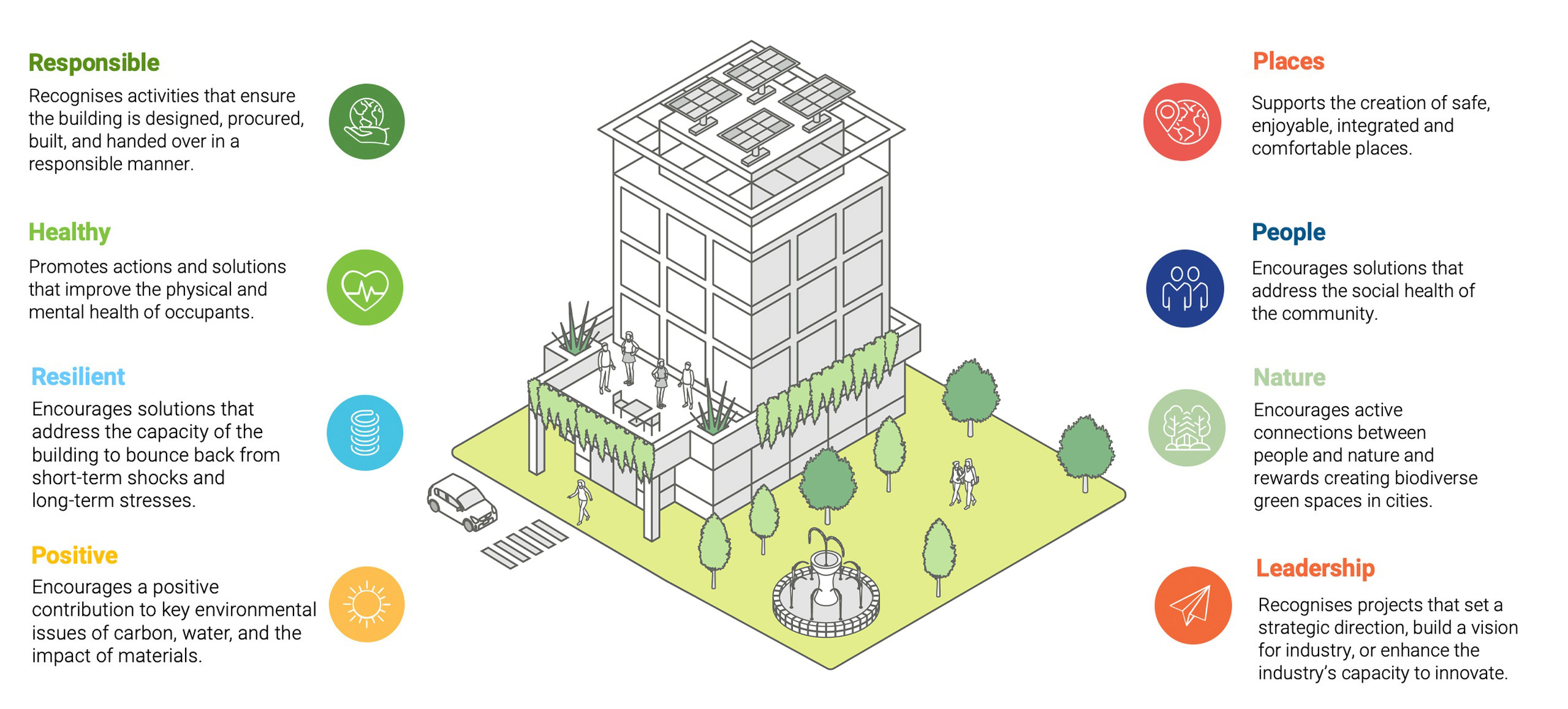
The four categories we can support with the most with excellent steel, ceiling, acoustic, and insulation products are Responsible, Positive, Healthy, People.
Green Star Products
Why Certification is Important
Good environmental performance is not the same as credit-ready evidence. Two identical products can perform the same way physically, but if one lacks the right certification, it won’t count towards a Green Star credit.
A product with recycled content or low emissions only counts for certification when supported by the precise documentation GBCA requires for that credit. Accepted evidence includes product-specific EPDs, GBCA-recognised ecolabels such as GreenTag and GECA, third-party low-emission test data, and chain-of-custody or material declarations where specified. Confirm the evidence pathway for each credit before locking in specifications.
Green Star Products from Armstrong Ceiling Solutions Australia*
-
- Armstrong Ultima, Ultima OP, Ultima OP dB
- Armstrong Bioguard Acoustic OP RH100
- Armstrong MetalWorks: Clip In, Lay In, Modular, One Way Hook-on, R-H215 Hook-on, V-P500 Acoustic Baffles, Vector, MetalWorks with B15 Infill, MetalWorks with OP15 Infill, MetalWorks with B19 Infill
*Information sourced from https://armstrongceilings.com.au/wp-content/uploads/BR_Sustainability.pdf
Green Star Products from Autex Acoustics*
-
- Autex Cascade
- Autex Cove
- Autex Cube
- Autex Frontier
- Autex Grid Ceiling Tiles
- Autex Groove
- Autex Hoirizon
- Autex Lanes
- Autex Lattice
- Autex Pressed Panel
- Autex Performated Tiles
- Autex Reform
- Autex Vicinity
- Autex Workstation
*information sourced from https://www.globalgreentag.com/products/autex-interior-acoustics/
Green Star Ratings and Studco Building Systems
Some of Studco’s steel products are suitable for Green Star builds and fit outs, and have been used in some of Australia’s highest-profile Green Star-rated buildings, including:
-
- The Pixel Building (Melbourne): The first building globally to achieve the highest possible Green Star rating.
- Library at the Dock (Melbourne): Awarded Australia’s first 6-Star Green Star rating for a public building.
- Barangaroo Commercial Towers (Sydney): A major urban development designed with 6-Star Green Star ratings.
- Upper House (Brisbane): Queensland’s first residential building to achieve a 5-Star Green Star As-Built certification.
Studco’s recycled steel content data is most relevant to the Responsible category, and can also support Positive category embodied carbon credits depending on how a project team structures its submission
Get the Right Products Specified From the Start
The projects that succeed are rarely those with the most ambitious sustainability targets, but those where product, credit and evidence have been aligned from the beginning, and that starts with the right supplier.
Ceilings By Design supplies leading sustainability-focused brands with the certifications to back them up. We can also assist with documentation requests and credit-aligned specification support.
If you are in the planning phase or working through a mid-project gap, get in touch with our team to confirm which products in your specification carry the certification your project needs.
NOTE: This article is correct as at July 2026 using the current information available on the Green Building Council Australia website.
Frequently asked questions
Yes. Products with multiple certified attributes can contribute to several credits across different categories simultaneously. A low-VOC ceiling tile with an EPD can support both an Indoor Air Quality credit under Healthy and a Responsible Products credit under Responsible. Mapping products to all applicable credits at the specification stage maximises their contribution to the overall project score.
Green Star Buildings applies to new construction and major refurbishments. Green Star Fitouts applies to tenant fitout projects within existing or new buildings, and runs on its own points scale rather than sharing one with Buildings. For ceiling, acoustic and framing product decisions, the key difference is category weighting: the Healthy category carries relatively more weight on Fitouts projects, while the Positive category carries more weight on Buildings projects due to higher total material volumes.
Any substitution needs to be assessed against the credit the original product was supporting. The replacement product must carry equivalent certification and evidence documentation to maintain the credit. If the replacement product can’t meet the same evidence requirements, the credit may need to be removed from the submission and replaced with an alternative. Your Green Star Accredited Professional should review any mid-project substitution before it’s finalised to confirm the credit position is maintained.
The GBCA publishes current credit criteria, submission requirements, and evidence guides through its Green Star portal at gbca.org.au. The Buildings and Fitouts tool documentation includes credit-by-credit requirements and evidence checklists. These are working reference documents, not introductory reading, and should be consulted alongside the guidance in this article.